graph LR
  OE["Opening Equity"] -->|"+10000"| B["Bank"]
  E["Employer"] -->|"+5000"| B
  B -->|"-3000"| R["Rent Expense"]
  B -->|"-1000"| F["Friend Owes Me"]
Intro
Your bank sends you a text: “Your account has been debited by ₹2,000.” Quick, is that good news or bad news?
If you paused even a fraction of a second, you’re not bad at finance, the word is bad at its job. “Debited” here means money left your account, which sounds bad, but “debit” in double-entry bookkeeping doesn’t mean increase or decrease at all. It means “left side of the ledger.” Whether the left side is good or bad news depends entirely on which kind of account you’re looking at, and that little sign-flip trick is precisely what makes debit/credit so confusing to non-accountants.
I’ve watched this alienate a lot of smart people, especially engineers, who get a half-semester crash course in double-entry as part of some “Fundamentals of Management” elective and walk away memorizing rules like “assets increase on debit, liabilities increase on credit” instead of understanding why. Commerce students drill this till it becomes muscle memory. Everyone else just quietly avoids ever touching their own books.
Here’s the thing though: double-entry bookkeeping itself is not confusing. It’s a genuinely elegant idea, older than calculus, and once you strip away “debit” and “credit,” it looks a lot like something every engineer already knows how to reason about: a conservation law enforced on a graph of accounts. or if i may be bold, The Law of Conservation of Mass Money
What “Debit” and “Credit” Actually Mean
NoteDefinition: T-account
Historically, ledgers were drawn as a capital “T” for each account, amounts written on the left were called debits, amounts written on the right were called credits. That’s the entire etymology. There is no inherent “increase” or “decrease” baked into either word.
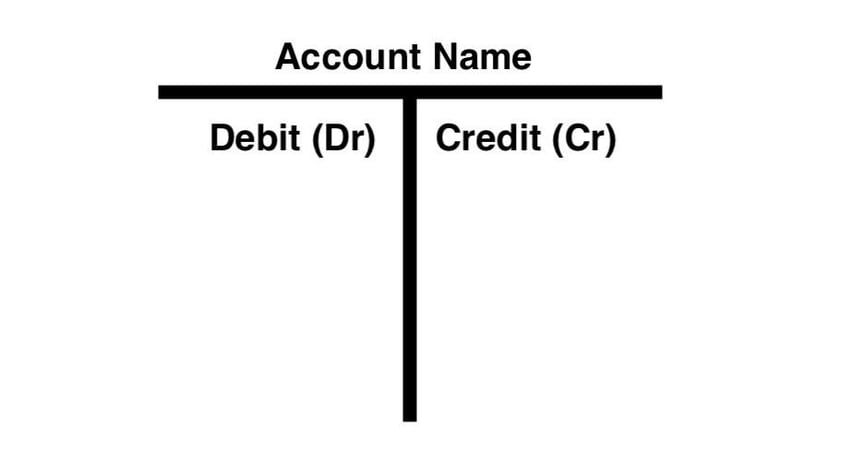
Whether a debit increases or decreases an account depends on what type of account it is:
| Account Type | Debit means | Credit means |
|---|---|---|
| Asset (cash, bank, inventory) | increase | decrease |
| Liability (loans, credit card owed) | decrease | increase |
| Equity | decrease | increase |
| Expense | increase | decrease |
| Income | decrease | increase |
Notice the pattern flips depending on which row you’re on. This is precisely why “your account was debited” is bad news for you (an asset decreasing) but the bank’s internal books record the exact same event as a credit decreasing their liability (they owed you that money, now they owe you less). Same transaction, opposite words, on two different books. No wonder this trips people up.
Rebuilding It Without the Two Words
Let’s throw out “debit” and “credit” entirely and rebuild double-entry from first principles, the way an engineer would.
The Naive Approach: One Balance to Track
Suppose you just want to track “how much money do I have.” The naive approach is a single running balance.
\[ \begin{aligned} \text{balance}_0 &= 10{,}000 && \text{opening balance in your wallet} \\ \text{balance}_1 &= \text{balance}_0 + 5{,}000 = 15{,}000 && \text{you get paid} \\ \text{balance}_2 &= \text{balance}_1 - 3{,}000 = 12{,}000 && \text{you pay rent} \end{aligned} \]
This works fine, right up until you have more than one place money can live. Cash in your wallet, money in your bank account, money owed on a credit card, money a friend owes you. The moment there’s more than one “bucket,” a single number stops telling you anything useful. Where did the ₹3000 for rent actually go? Which bucket shrank? Which one grew?
The Fix: Every Transaction Touches Two Buckets
The core insight of double-entry bookkeeping is deceptively simple: money never just appears or disappears, it moves from one account to another. So instead of tracking one number, we track every transaction as a pair of accounts, and a signed amount.
| date | from | to | amount | description |
|---|---|---|---|---|
| 2026-08-01 | Opening Equity | Bank | 10000 | Opening balance |
| 2026-08-01 | Employer | Bank | 5000 | Salary |
| 2026-08-02 | Bank | Rent Expense | 3000 | August rent |
| 2026-08-05 | Bank | Friend Owes Me | 1000 | Lent to Rahul |
Every row says the same thing: “this much money moved from this account, to that account.” No debits, no credits, just a direction and a magnitude, exactly like a signed edge in a graph.
Drawn out, our four transactions look exactly like what they are, a directed graph, with accounts as nodes and transactions as signed edges.
TipThe one rule that replaces debit/credit entirely
For every transaction: subtract the amount from from, add the amount to to. That’s it. That single rule replaces the entire debit/credit sign-flip table above.
Computing Balances
To get each account’s balance, we just aggregate the outflows and inflows. For any account \(a\), its balance is simply everything that flowed in minus everything that flowed out:
\[ \text{balance}(a) = \sum_{\text{to} \,=\, a} \text{amount} \;-\; \sum_{\text{from} \,=\, a} \text{amount} \]
Applying that to our four transactions gives:
| account | balance |
|---|---|
| Bank | 11,000 |
| Opening Equity | −10,000 |
| Rent Expense | 3,000 |
| Friend Owes Me | 1,000 |
| Employer | −5,000 |
Look at that, no jargon required. Bank nets out to 11,000 (received 10,000 opening + 5,000 salary, paid out 3,000 rent and 1,000 lent to a friend). Rent Expense shows 3,000. Friend Owes Me shows 1,000, an asset representing money you’re owed. Every number is intuitively signed: positive means “this bucket grew,” negative means “this bucket shrank.” No context-dependent flipping required.
The Invariant Every Engineer Will Recognize
Here’s the part that should feel familiar: because every transaction moves the same amount out of one account and into another, the ledger as a whole always nets to zero. This is just conservation of mass, applied to money.
\[ \sum_{a \,\in\, \text{accounts}} \text{balance}(a) = 11{,}000 - 10{,}000 + 3{,}000 + 1{,}000 - 5{,}000 = 0 \]
This is, in disguise, the accounting equation Assets = Liabilities + Equity, usually taught as a rule to memorize. But it isn’t a rule you need to memorize at all, it’s a consequence of the fact that money only ever moves between accounts, never created or destroyed by a transaction. If your ledger ever fails this check, you have a bug, literally an unbalanced entry, the exact same way a conservation-law assertion failing tells you a physics simulation has a bug:
\[ \sum_{a \,\in\, \text{accounts}} \text{balance}(a) \;\stackrel{!}{=}\; 0 \]
Where “Debit” and “Credit” Sneak Back In
I’m not arguing the words should be abolished, accountants have used this vocabulary for over 500 years1 and it’s not going anywhere in professional practice. But for someone learning the concept, “debit” and “credit” are an unnecessary layer of indirection between you and a genuinely simple idea: signed flows between accounts that must always net to zero.
If you’re an engineer trying to build a mental model of double-entry bookkeeping, or building software that needs one (a ledger, a wallet system, an internal billing engine), skip the T-accounts and the memorized sign table. Model it as a graph: nodes are accounts, edges are transactions, each edge has a signed amount, and the whole graph must always sum to zero. Tools like ledger-cli and beancount are built on almost exactly this model internally, which is probably why engineers who’ve had to read their source or docs tend to find double-entry bookkeeping far less mysterious than the rest of us.
Conclusion
“Debit” and “credit” aren’t wrong, they’re just bad UX for a genuinely elegant idea. Double-entry bookkeeping is a conservation law: every transaction is a signed edge between two accounts, and the whole system must always balance to zero. Once you see it that way, you don’t need a table of sign-flip rules, you just need to ask “where did this money come from, and where did it go,” and the arithmetic takes care of itself. Happy Ledgering!
References
Footnotes
Luca Pacioli, an Italian Franciscan friar, formally described the double-entry method in 1494 in Summa de Arithmetica, which is why he’s often called the “Father of Accounting.”↩︎
Reuse
Citation
BibTeX citation:
@online{katti2026,
  author = {Katti, Vishal},
  title = {Accounting Is {Just} a {Signed} {Graph}},
  date = {2026-08-02},
  url = {https://vishalkatti.com/posts/accounting-as-signed-graph/},
  langid = {en},
  abstract = {This post rants a little about how the words “debit” and
    “credit” confuse more people than they help, and then rebuilds
    double-entry bookkeeping from scratch as a simple, signed graph of
    accounts that any engineer can reason about.}
}
For attribution, please cite this work as:
Katti, Vishal. 2026. “Accounting Is Just a Signed Graph.”
August 2, 2026. https://vishalkatti.com/posts/accounting-as-signed-graph/.